
transcribed 24 Nov 2010 in Monroe, Maine by Eric Rector
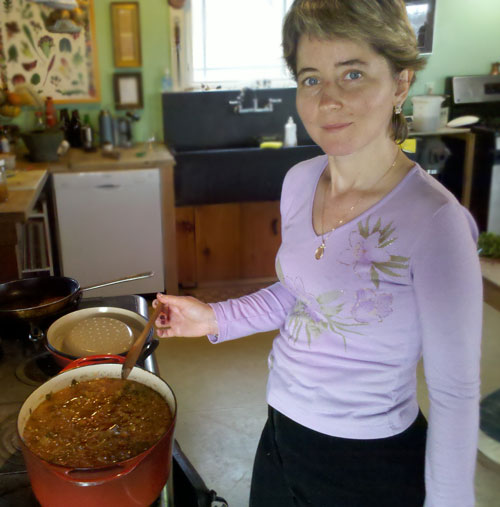
Our borscht professor: Natalia Topchii
“Alison and I had the pleasure of hosting Brian and Natalia for Thanksgiving this year, and I took the opportunity to document the Ukrainian Borscht recipe that Natalia taught me in Reno in June. Alison and I have made borscht for as long as we’ve taken cooking seriously — it’s a versatile soup that can be vegetarian or not, chunky or smooth, served hot or cold. It’s basis in root vegetables and storage crops lends itself to the things we grow in our garden and on our land. We normally grow everything but the bay leaves and the peppercorns in this recipe.
Before we met Natalia, she had heard that we liked to cook borscht and she emailed us her recipe to try, which we did. But there was no cabbage in the recipe, and other ingredients were probably lost in the translation, like ‘is paprika the powder of dried Hungarian peppers? or is it a fresh green bell pepper?’ It was still good, of course — it’s hard to go wrong cooking beef and vegetables together into a satisfying soup. But, of course, I’m chasing authenticity.
In that search, I’ve visited the Polish and Ukrainian restaurants on Lower East Side of Manhattan many times — the food is good, filling, and cheap — and had several versions of their borscht. However, after I sent an article in the New York Times profiling the history of one of these restaurants to Natalia (through Brian), she declared: ‘I do not recognize these dishes…this is not Ukraine food.’ Definitively. I know that there is a wide variation in recipes for the same dish across cultures, but I also know that when foreign dishes are adopted by American diners, they necessarily change as well and take a life of their own. bratwurst becomes hot dogs…focaccia becomes pizza, etc. So I was interested in a taste from the source, and Natalia could provide that for me. (See also “Memories Of Borscht” in the New Yorker food issue this November.)
The first time she showed me how to make Ukrainian Borscht was in Reno this June right before the Anniversary Party we threw for Marc and Carol. There were lots of interesting differences in her recipe that I noted, but admittedly I was too focused on the Party to document the recipe appropriately. The next time we saw Natalia and Brian was Thanksgiving week, and I planned for one day to be devoted to Borscht (many other ‘smatch-no’ items were produced as well, but that may be for another post). Following is the result.
Oh, also, the most authentic instruction given by Natalia in the course of teaching me how to make a true Ukrainian Borscht: almost every ingredient is optional and variable. No beef shin? OK, any beef is good, or hamburger will do. Or pork, or lamb (but never chicken). But beef stock is not necessary — you make your stock with your fresh meat. It is much better that way. Beets? That which would seem to make soup borscht? Optional. Potatoes? If you wish, one or three or five. Apple is very good, but not necessary. Carrots can be left out, as can green pepper, or can be used in larger quantity if you wish. Some people don’t like cabbage — that’s OK. But NEVER add celery — we don’t do that. Garlic is good, but never more than one clove in the pot — save the rest to mash and mix with bread. Parsley (that’s what we used because it was still growing in our garden, improbably through many frosts) is OK — dill leaves are much better. So much better that Natalia normally grows dill through the year, outside in the spring and summer, inside in the fall and winter. Which means that borscht is really just a soup with dill. Go for it.”
–Eric
Ingredients:
vegetable oil (peanut oil is preferable)
1 medium onion
1 pound beef shin with bone
3 quarts water
1 teaspoon salt
2 medium carrots
1 large (or two small) beet
1 green bell pepper
3 medium waxy potatoes (like Yukon Gold, Kennebec, or other boiling potatoes)
1 clove garlic, chopped (not minced or pressed)
1 apple, peeled, cored, grated
1 handful of chopped fresh parsley, dill leaves, sorrel leaves, or other green herbs of your choice
1/2 medium green cabbage head
1 can tomatoes (small can paste, regular can sauce)
2 bay leaves
3 black peppercorns
salt and sugar to taste






 Monday, I went into tomato canning anxiety — the canning kettle package urged use of the Ball recipes and procedures for canning and preserving. It’s not like home canning is a mystery, but I’ve never done it before, thus, read research and generally go into paralysis by analysis. And I couldn’t start canning and have to finish after the Giants game started at 4:58pm. But Monday wasn’t a total waste. I made a trial quart of peeled Early Girls to see how they fit in the jar. Having experienced that, I made juice with those tomatoes. It tasted pretty good, but that’s a lot of work for tomato juice to drink with breakfast.
  eats for one