Country Rope Sausage

A few years ago, Carol’s folks gave us a gift pack of ham and sausages from Burgers’ Smokehouse. Good stuff. We’ve ordered from them a few times… always ham – oddly, it’s hard to find good country ham in San Francisco – and something we haven’t tried. This time it was Country Rope Sausage.

b_sausage_n_oil

The rope sausage comes in three flavors, mild, medium and hot… I chose the mild to start with and followed the package directions to cook.

“Preheat skillet to 300 degrees. Add 1/4 cup oil and 1 lb. Burgers Rope Sausage. Cover and brown for approximately 8 minutes. Turn and brown an additional 8 minutes. Reduce heat to 250 degrees. Add 1 cup water. Cover and cook for approximately 8 minutes. Turn and cook for an additional 8 minutes or until done. Use meat drippings for milk gravy or fried eggs.”
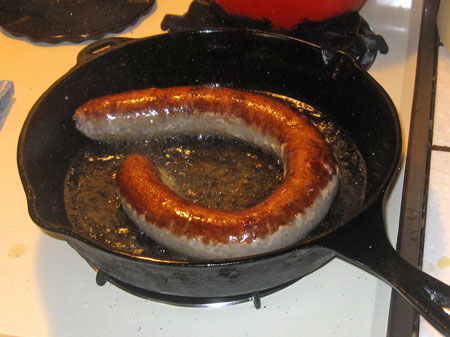
b_rope_browns

I figured medium heat would be about 300 degrees for my cast iron skillet, and my oil of choice was olive oil since I would be using the drippings for a vegetable saute.

b_rope_steams

For my vegetable saute, I peeled and sliced one green pepper, one onion and half a large bulb of fennel. I added thyme to the mix and when the vegetables were almost tender, added some white wine to finish.

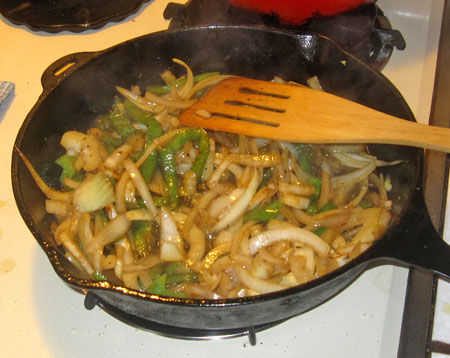
b_vegetablesb_veg_cook

The sausage is a medium fine grind and turned out perfectly browned, moist and tasty. The vegetable saute was a superb accompaniment.

b_rope_served

Damn fine brunch, but I got to thinking I ought to be feeling a twinge of guilt.

That morning, I attended a talk by Michael Pollan on his book Food Rules. I’m a big fan and have read most of his other books. One of the basic tenants of his philosophy is knowing where your food comes from. Well, this sausage came from Burgers’ Smokehouse in California, Missouri. But where do they get their meat? Their web site is all about their smokehouse and marketing… no mention of where and how their pork is raised.

They do say,

“By 1956 Mr. Burger was producing around 5,000 hams annually so he curtailed his farming activities to devote more time to the ham business. An expansion program was outlined. On July 23, 1956, the company became the first country cured meat company in the United States to receive Federal Inspection.

The family-owned corporation now comprises more than 305,545 square feet and is still located on the original site. Interestingly enough, that first little 1952 building remains a part of the existing plant complex. At the present time, the company produces 750,000 hams, bacon, sausage and a dozen other specialty meats.”

With trepidation, I sent them an email and asked the question.

Subject: a question about your products
From: Marcus Rector
Date: January 25, 2010 10:43:42 AM PST
To: service@smokehouse.com

A few years ago, we were given a gift pack of ham and sausage from Burgers’ Smokehouse. Good stuff. We’ve ordered from you two or three times a year since then. Oddly, it’s hard to find good smoked ham in San Francisco.

I buy nearly all my meat at the Ferry Plaza Farmers Market in San Francisco, so I know where it comes from and how it is raised. Where does the pork that you process in your smokehouse come from and how it is raised?

Sincerely,
Marcus Rector

From: service@smokehouse.com
Subject: Re: [Bulk] a question about your products
Date: January 25, 2010 1:38:57 PM PST
To: Marcus Rector

Our pork come from commercial producers in our state or from surrounding
states such as Iowa and Kansas.  All our meat products are USDA inspected
and first quality.
Thank you for the inquiry,
Edwena Shock
Customer Service for the Smokehouse

I have to reason that if their pork was free range, grass fed, heritage breed or any of that, they would say so. By buying from them I am indirectly supporting industrial feed lots. But their pork products are so good… they really know how to handle their spices and curing. Their ingredients are certainly straightforward: pork (including hams, loins and tenderloins), water, salt, seasoning (spices), sugar, monosodium glutamate.

So a nice brunch turns into a moral dilemma. I buy mostly local, and foods that are in season locally, but I’m not a fanatic. And is buying from Burgers’ Smokehouse any different than buying meat from Safeway?

Good sausages are certainly available at the Farmers Market, but not like these. And as I said, I haven’t found good country ham in San Francisco. So I will continue looking for that stuff at the market, continue to support the meat merchants at the market and rationalize my paltry one or two purchases a year from Burgers.

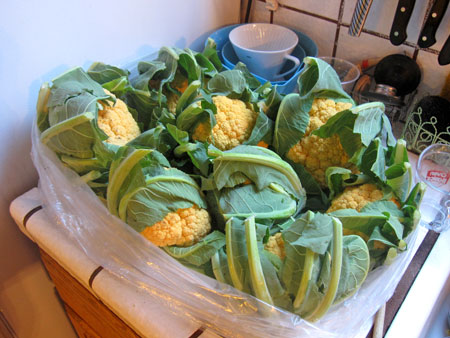
Cauliflower Friday

wc_caulif_detail

I got the email notice that the Mariquita “Truck Farm” was coming to town on Thursday.

“I’ll have orange cauliflower, fennel, butterball potatoes, and bay leaf wreaths: all by pre order only! Orange cauliflower? This is a variety that is a nice orange color, and it stays orange when cooked. We harvest it truly fresh, so it’s sweet when cooked. The leaves are great too! just like a kale. really. Cook them up!”

What a great opportunity to go on a cooking binge, but only ten pounds, not like the 40 pound tomato binges of the summer. I was glad to order, and the price was right, 10 pounds for $12.

wc_8_heads_caulif

What to do with it? A couple soups, some kind of pickled, something on the stove as a vegetable and something with the leaves. I rounded up some cauliflower recipes and adapted some other recipes to use cauliflower.

Leek and Cauliflower Soup — I adapted this from a favorite potato leek soup recipe by Jacques Pepin.

Pickled Cauliflower, adapted from Market’s House Made Pickles from the Market Restaurant in St. Helena.

Roasted Cauliflower Soup — I had made this before with white cauliflower. It’s from Anne’s Food blog, Stockholm, Sweden. OK, another soup, but quite different, and it uses up a lot of cauliflower.

Sauteed Braised Cauliflower adapted from Sauteed Braised Broccoli Romanesco from The Victory Garden Cookbook by Marian Morash via Mariquita Farms newsletter.

And finally, Braised Cauliflower Leaves. — I just made this up as I went along, based on the many greens I had cooked over the years. Continue reading

Sausage Soup

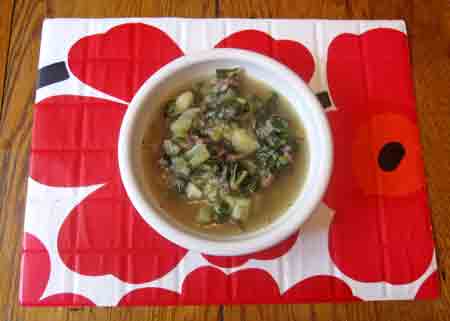
with leek, potato, green chard

w_fra_soup_detail

Perusing the cooked sausage area at Whole Food, looking for something appealing, I spotted the Fra’Mani Classic Italian Sausage. I respect Paul Bertolli from his years as the chef at Oliveto in Oakland, his book, Cooking by Hand and the many Fra’Mani salumi I have sampled; but I didn’t much like this sausage. I first ate one steamed and fried, with mustard on a bun. It seemed chunky and tough prepared that way. The sausage is ground very coarse, so there are sizable chunks of meat and fat. Taste 10, texture 3, sez I, paraphrasing the song from A Chorus Line. I tried another sausage cubed and hashed with potatoes and celery. Same deal. Cubed in soup… same.

w_fra_label

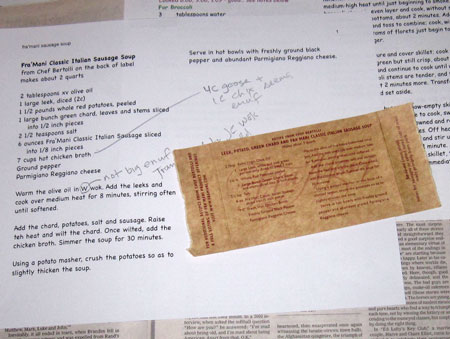
Then I noticed a recipe on the back of the label – Leek, Potato, Green Chard and Fra’Mani Classic Italian Sausage Soup; a rather verbose, but descriptive title. For this, the sausage is sliced thin. I gave that a try. Excellent. Sliced thin, the chunks of meat are broken down and the chunks of fat melt into the soup. What an amazing transformation. I guess I’ll be back for more.

w_fra_ingredients

Winter soups with leeks, potatoes and greens are not uncommon, and the addition of the tasty cured sausage is welcome. My addition of the goose stock; oh my… it’s like buttah, smooth and velvety.

w_fra_served

Fra’Mani Classic Italian Sausage Soup
from Chef Bertolli (on the back of label)
makes about 2 quarts

2 tablespoons xv olive oil
1 large leek, diced (2c)
1 1/2 pounds whole red potatoes, peeled
1 large bunch green chard, leaves and stems sliced into 1/2 inch pieces
2 1/2 teaspoons salt
6 ounces Fra’Mani Classic Italian Sausage sliced into 1/8 inch pieces
7 cups hot chicken broth [I used 4 cups homemade goose stock and 2 cups chicken stock.]
Ground pepper
Parmigiano Reggiano cheese

Warm the olive oil in a heavy bottom soup pot. Add the leeks and cook over medium heat for 4-5 minutes, stirring often until softened.

Add the chard, potatoes, salt and sausage. Raise the heat and wilt the chard. Once wilted, add the chicken broth. Simmer the soup for 30 minutes.

Using a potato masher, crush the potatoes so as to slightly thicken the soup.

Serve in hot bowls with freshly ground black pepper and abundant Parmigiano Reggiano cheese.

That was so good. I looked at the label more carefully, seeking more.

“Serving suggestions: Serve with boiled Italian cannellini beans seasoned with onions and sage. Slice thinly and use as a pizza topping. Chop finely and simmer with soffritto and tomatoes for ragu. For additional recipes from Chef Bertolli, visit http://www.framani.com.”

Natasza Salad

beets and more

w_n_salad_fish

Visiting son Brian in Reno, we were treated to a fine meal of grilled fish and what I will call “Natasza Salad.” It is a traditional Ukraine salad of beets, carrots, potatoes and celery and was prepared by Brian’s friend Natasza from Kiev. It was simple and delicious, so naturally, I wrote down how to make it:
“Roast and dice beets, dice and steam carrots, potatoes and celery, dice cornichons. Combine and toss with oil and vinegar.”

I got around to making it for dinner yesterday as root vegetables are prevalent this time of year. I love beets and get a few about every week at the Farmers. Though I find red beets incredibly beautiful, I’ve taken to buying golden beets lately; they taste the same and don’t bleed, so they’re great for salads.
w_nataza_ingred

Carol asked me to get celery root (celeriac) a couple of weeks ago. She does that, saying she wants to make this or that. It’s time to use it or lose it, so I substituted celeriac for the celery. I didn’t have quantities, so I decided to start with a small and a medium beet and match the other ingredients to that.

2 beets cubed – slightly more than a cup
1 cup diced carrots
1 cup diced Carola potatoes
1 cup diced celeriac
5 cornichons sliced thick
Sea salt and freshly ground pepper
1 head lil gem lettuce, leaves separated

Steam carrots, potatoes, celeriac for 5 minutes. While hot, toss with beets. Fold in cornichons. Dress with vinegar and olive oil.

Arrange lil gem leaves on a plate and spoon salad on to the leaves.

w_natasza_served3

Notes:
Dressing – I used a traditional mix of 1 part red wine vinegar to 3 parts xv olive oil — olio nuovo in this case. This salad needed more acid. Next time, I’ll use 1 part vinegar, 1 part cornichon juice, 3 parts oil.

Cornichons – 5 cornichons yield less than 1/4 cup. Needs double that amount.

Served with leftover ham loaf, sliced and fried in butter.

Good. Yum.